
Have you ever wondered if dogs have any sense of time, and if so, how much? After all, we’ve all spotted the clues: your dog waiting by the door exactly when it’s time for walkies, or politely reminding you with a nudge that dinner is running late… well, these moments make us think that dogs do know the time, even if they haven’t yet learnt the habit of wearing wristwatches.
The great news is, understanding how dogs understand time can also give us a deep appreciation of how dogs experience the world, as well as how we can support them. Let’s take a look at what this really means.
How Do Dogs Know the Time?
Dogs don’t use clocks, calendars, or countdowns, and they definitely don’t understand abstract ideas like “yesterday” or “tomorrow”. Instead, time for dogs is shaped by their biology, as well as patterns and learning.
Circadian Rhythms: A Dog’s Internal Clock
Like humans, dogs have natural circadian rhythms—biological processes that follow a roughly 24-hour cycle. These rhythms influence:
- Sleeping and waking
- Appetite
- Hormone levels
- Daily energy patterns
This internal clock helps dogs anticipate certain parts of the day, even without knowing the actual hour.
Routines & Giving Dogs Structure
Similarly, a consistent routine helps dogs feel safe. Over time, dogs learn the sequence of your day—things like:
- When you wake up and start getting ready
- When the house gets quiet in the afternoon
- When the family settles into the living room in the evening
These little patterns serve as markers of time for dogs, helping them instinctively understand when something is due to happen.
Associations & Learning
And leading directly on from this, dogs quickly learn that certain events follow other events. For example:
- The sound of you picking up your keys and the lead means it’s time for a walk
- Opening that particular cupboard in the kitchen usually means dinner must be on the way
- Sitting down with a cup of tea in the evening? It must be bedtime soon
Dogs can even anticipate your return by recognizing familiar sounds, such as the engine of your car pulling into the driveway or your distinctive footsteps on the pavement outside. And it’s these associations that form a key part of how dogs know the time.
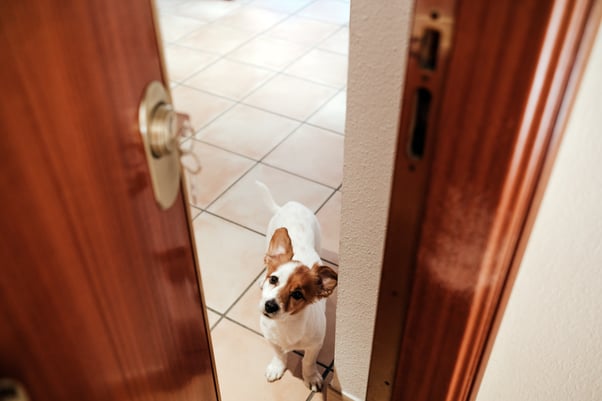
Do Dogs Know How Long You’re Away?
Many pet parents feel their dog reacts differently depending on how long they’ve been gone—and research supports this. Dogs have been known to greet their humans more enthusiastically after long separations, further supporting the idea that dogs do have a concept of time—even if it’s not the same as ours!
Studies suggest that dogs can sense the passing of time through:
- Changes in scent (such as your scent fading)
- Hunger cycles
- Boredom or restlessness
- Daylight shifts
- Learned patterns of your usual schedule
This doesn’t necessarily mean that dogs know what a minute or an hour is. They simply recognize that more time has passed based on environmental changes.
Do Dogs Experience Time Differently From Humans?
Although dogs can remember experiences and anticipate future events, they live more “in the moment” than humans. Their days are generally guided by what’s happening right there and then.
Interestingly, some researchers have suggested that dogs may actually experience time slower than us. Because dogs have a faster metabolism and sensory processing than humans, moments in time can feel more drawn out—making short absences feel much longer and longer ones more profound.
Hence the excitement when you return after just popping out for five minutes!
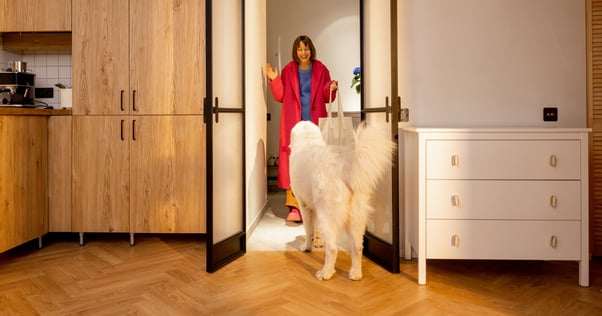
Dog Years to Human Years: How Dogs Experience Time as They Age
A common question linked to time is how we compare dog years to human years. The idea that one dog year equals seven human years is outdated. However, we can still estimate ageing patterns in dogs:
During the first two years, dogs age very rapidly—the equivalent of roughly 10 – 15 human years per dog year. After that, dogs age around 4 – 5 human years each dog year. And size matters during this too, with small dogs tending to age slower than larger breeds.
This helps explain why puppies mature so fast and why senior dogs may need support sooner.
So… Do Dogs Have Any Concept of Time?
Dogs may not understand hours or calendars, but they absolutely experience the passing of time. Time for dogs is all about:
- Patterns
- Instinct
- Environmental cues
- Memories
- Associations
Your dog doesn’t need a clock—they have you, their routine, and the world around them to guide their sense of time!
Supporting Your Dog Throughout the Day
Whether your dog is anticipating walk time, waiting for you to come home, or adjusting to a new routine, ADAPTIL is here to help them feel safe and supported. Products like the ADAPTIL Calm diffuser help create a calming environment, perfect for dogs who may feel unsettled by changes in their daily patterns or routine.
For more tips on dog behaviour and well-being, explore our blog—and don’t forget to sign up for our newsletter to stay up to date with the latest insights!
Leave A Comment
Want to sign up for our blog?
Information Notice
The personal information collected is intended for Ceva Santé Animale, and Ceva group companies, in order to manage your request.This information may be passed on to service providers in order to organize this management. In accordance with the Regulations on personal data you have rights of access, rectification and limitation of processing of your data. You may also, in certain limited cases, oppose the treatment, withdraw your consent and request the deletion and portability of your data. For any request relating to your personal data please go to this page